The photograph below was taken in 2009 from the same place as the one above. The building in the background is Asda Stores.
 The
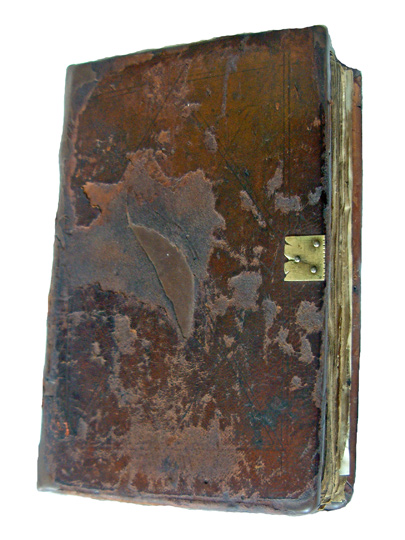
book in the photograph on the left is the Registrum Vetus Ecclesia Glasguensis
- Latin for the Old Register of the Church of Glasgow. It is a chartulary of documents
belonging to the medieval Diocese of Glasgow between the twelfth and fifteenth
centuries, making it over 800 years old. Within it, folio 48, from the year 1226,
contains the earliest known reference to a Catholic Church in Ardrossan. Titled
'De Ecclesiis de Ardrossan et de Dalri', it describes an agreement between the
Archbishop of Glasgow and the Abbot of Kilwinning whereby the Archbishop granted
the Abbot a pension payable from the Church of Ardrossan. Folio 48 can be seen
under Registrum Vetus on the Pictures
page. The Registrum Vetus is held in the Scottish
Catholic Archives in Edinburgh.
The
book in the photograph on the left is the Registrum Vetus Ecclesia Glasguensis
- Latin for the Old Register of the Church of Glasgow. It is a chartulary of documents
belonging to the medieval Diocese of Glasgow between the twelfth and fifteenth
centuries, making it over 800 years old. Within it, folio 48, from the year 1226,
contains the earliest known reference to a Catholic Church in Ardrossan. Titled
'De Ecclesiis de Ardrossan et de Dalri', it describes an agreement between the
Archbishop of Glasgow and the Abbot of Kilwinning whereby the Archbishop granted
the Abbot a pension payable from the Church of Ardrossan. Folio 48 can be seen
under Registrum Vetus on the Pictures
page. The Registrum Vetus is held in the Scottish
Catholic Archives in Edinburgh.
In the mid nineteenth
century, there were only two permanent Catholic churches in Ayrshire. They were
in Ayr and Kilmarnock. In 1851, a new church was built in Dalry. It was administered
from Saint Mirin's Church in Paisley and served the Catholic population of Dalry,
Glengarnock, Kilwinning, Stevenston, Saltcoats, Ardrossan and West Kilbride.
Over the next few years, several more churches were built. These were at Saltcoats
in 1853, Kilbirnie in 1862, Irvine in 1862, Largs in 1869, Kilwinning in 1872
and Stevenston in 1905. When another new church opened in West Kilbride in 1907,
Ardrossan was the only town in its locality without its own Catholic church.
In 1916, to commemorate the Golden Jubilee of the opening of Saint Mary's Church,
Saltcoats, a booklet, called 'History of the Catholic Church in Saltcoats' was
published. It stated that in the early 1850s, Mass was said in Saltcoats
every six weeks by Father Thompson of Ayr or Father Wallis of Cumnock who rode
over on horseback on a Sunday and celebrated the Holy Sacrifice for the faithful
few who gathered in the old loft in Bradshaw Street. Saint Mary's Church
opened in Saltcoats on 13 April 1856 under the stewardship of Father William
Hallinan who had the title Parish Priest of Saltcoats and Ardrossan. As well
as performing his pastoral duties over a very wide area, Father Hallinan would
go - usually on foot - to Kilwinning on Sundays to say an early Mass then return
to Saltcoats for another Mass at midday. In the early 1900s when Father Patrick
Ryan was the Parish Priest based in Saltcoats, the work of the four Parishes
of Stevenston, Saltcoats, Ardrossan and West Kilbride had to be performed by
the one priest at Saltcoats. Mass was said once a month in West Kilbride and
on that Sunday, Saltcoats had only one Mass. In October 1901, Father William
Keogh was appointed to Saltcoats as its first curate. Stevenston, whose Catholic
population had increased by leaps and bounds, was now making such heavy demands
on the priests of the Parish that it was considered the time had come for it
to be established as a separate Mission and so on 2 July 1905, Saint John's,
Stevenston was opened. Father Ryan, during his pastorate of Saltcoats acquired
the site for the building, superintended its construction and as Father Hallinan
was the founder of the Mother Mission at Saltcoats, so was Father Ryan the founder
of its offspring, Saint John's, Stevenston. In 1907, Father Francis Cronin,
then Saltcoats Parish Priest, procured the ground and had plans drawn out for
a Church in West Kilbride. On Father Cronin's transfer, his successor, Father
William Carmichael took over the supervision of the construction and Saint Bride's
Church opened on 3 May 1908. The first Mass was celebrated by Father William
Keogh of Saltcoats.
Between 1926 and the
opening of the Church of Saint Peter in Chains, Sunday Mass in Ardrossan was
said in the Assembly Hall in Bute Place off Princes Street, by courtesy of its
owner, Harry Kemp.
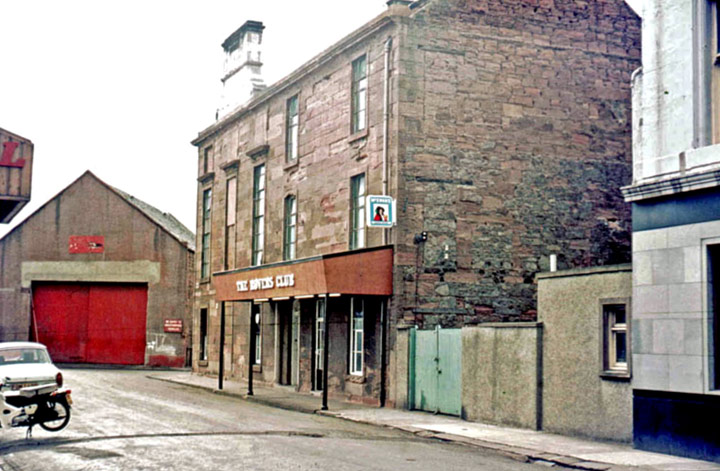
The Hall was the large building in the centre of the photograph below, taken
in 1974. The first Mass in the Hall, and indeed the first Mass in Ardrossan
since the seventeenth century, was celebrated by Father
Robert McCliment, a native of the town. Children's devotions were held on
Sunday afternoons.
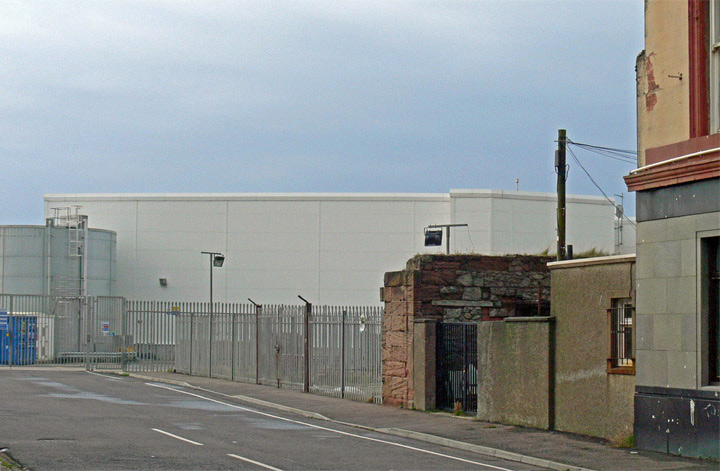
The photograph below was taken in 2009 from the same place as the one above.
The building in the background is Asda Stores.