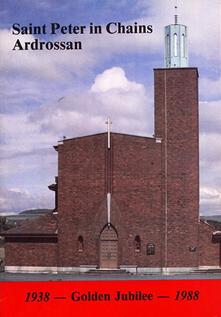
GOLDEN
JUBILEE BOOK
To commemorate the Golden Jubilee, Tom McGrattan wrote a book called Saint Peter
in Chains, Ardrossan - A Parish History.
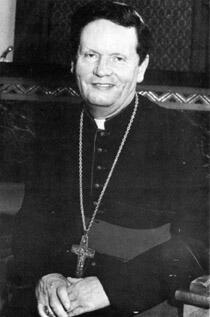
Maurice Taylor, Bishop of Galloway wrote the preface.
It is with
great pleasure that I write these words as a preface to this book. With you
I give thanks to God for the impressive building that is Saint Peter-in-Chains,
fifty years old this year.
The fine architecture of the building, its prominent and imposing location on the sea-front and the magnificent setting of the Firth of Clyde all combine to make it one of the outstanding churches of the Diocese of Galloway. This is very fitting because the parish community has become the largest in the Diocese.
For all who are parishioners, the building will have memories, most of them happy, but some of them sad. So it is right that we should thank God for the faithfulness and constancy of those no longer among us. May they enjoy everlasting peace in heaven.
We also ask God, through the prayers of the Apostle Peter, to set us free from any chains that bind us and to give us the grace of being renewed in the Holy Spirit. May St Peter's continue to serve the parish community for many years to come and may that community grow in faith, hope and love, ever closer to Christ as his disciples and truly committed to building God's kingdom on earth.
This is my prayer for each one of you as I share in your joy and thanksgiving.
Yours sincerely in the
Lord
SAINT PETER IN CHAINS
Pre Reformation
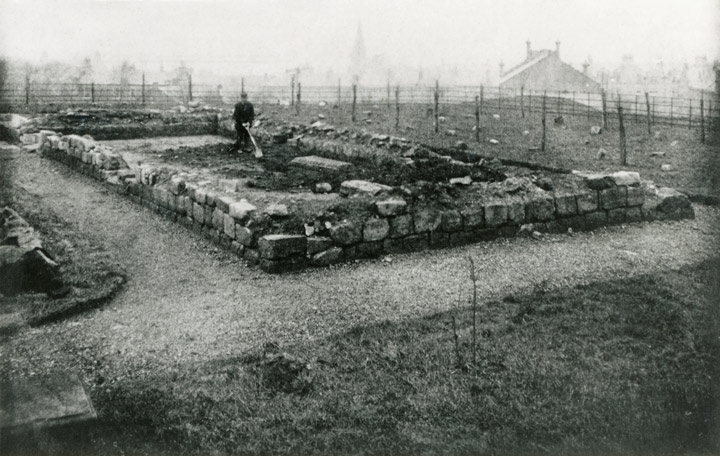
The remains of the outline of the original church in Ardrossan can still be
seen 300 metres north of the present church on Castle Hill commonly known as
the Cannon Hill. Arthur Guthrie in his book, Ardrossan, Saltcoats and Neighbourhood
of 1882 describes this "The foundations of the church show that the building
must have been very small - of a simple oblong form, and measuring 64 feet by
26 over the walls." This Parish Church of Ardrossan was dedicated to Saint
Bridget. Saint Bridget or Bride, who gave her name to nearby West Kilbride,
was an Irish missionary who came in the fifth century to the then pagan West
of Scotland and landed at Seamill. The church contained two altars dedicated
to Saint Peter and the Blessed Virgin Mary. Early parishes in Scotland were
the estates of the feudal lord who would build a church on his land and appoint
a priest. An old charter of March 1438 states that John Lockhart, Lord of Barr
provides for an annual rent, from the lands of Barr and Neilstoun, to be paid
to the chaplain for saying three masses for the repose of his soul at the altar
of Saint Peter in Ardrossan Church.
The earliest recorded documentation of this church dates from 1226 and describes an agreement between Walter, Archbishop of Glasgow and John, Abbot of Kilwinning whereby the Abbot received a pension of sixteen shillings a year from the Church of Ardrossan. At that time this and neighbouring churches were administered by monks from the Abbey of Kilwinning which was established in the twelfth century by members of a branch of the Benedictine Order founded by Saint Bernard of Tiron in Normandy. In a 1911 report to the Commission of Ancient and Historical Monuments (Scotland) on the clearing out with a view to preservation of Ardrossan Castle, which was built during the fourteeenth century, Doctor Thomas Ross suggests there may have been a chapel there "In the north west side of the courtyard the excavations have revealed what appears to be a chapel, lying east and west. In its south wall there are two windows and a door towards the west which have a decided ecclesiastical appearance with broad splays on the jambs and checks on the ingoing of the window for glass." David H Caldwell in his 1972 publication, Ardrossan Castle, Ayrshire: A Preliminary Account, writes "There is one such window sill in situ in the east wall of this western range, but this position does not seem to agree with Doctor Ross's description. In fact, unless Doctor Ross has got his orientations entirely the wrong way round it is difficult to reconcile his description with the surviving remains. That there should have been a chapel there does however seem a valid hypothesis."
The church on Castle
Hill also served another in Saltcoats which was dedicated to Saint Meddan. It
stood on the site of the present Erskine Memorial Church in Chapelwell Street,
then called Chapel Brae. This church continued to serve the local population
until it fell into disuse in 1567. Following the period of the Reformation,
the church lands, which belonged to the Abbey of Kilwinning, were passed to
the Earl of Eglinton. A storm in 1695 destroyed the Church of Ardrossan.
During excavations carried out in 1911 on the remains of the church on Castle
Hill a stone coffin was found. The lid measured 2.2 metres long and 230 millimetres
thick and is very ornately decorated. Doctor Ross comments "The carved
lid is, as far as I know, one of the finest things of its kind in Scotland and
is a specimen of mediaeval art its purest and best period, not later, I believe,
than the thirteenth century." This coffin, probably that of one of the
Barons of Ardrossan, was removed and displayed in the entrance hall of Ardrossan
Burgh Chambers in Kilmahew Street. It can now be seen in the North Ayrshire
Museum in the Kirkgate Saltcoats. It is interesting to note that, between 1773
and 1908, this building was Ardrossan Parish Church, a direct descendant of
that where the coffin was found.
New Beginnings
In 1822, the Church of Saint Margaret was built at Ayr and occasionally Father William Thompson, its resident priest on horseback to Saltcoats to say mass. This church in Ayr was one of only five churches in the West of Scotland, stretching the length of the Ayrshire coast, to Glasgow and inland to Lanarkshire, which were in existence in 1840. In the quarter century that followed fifty four new churches were completed and eighteen existing churches were extended.
In 1853 the Catholic Church was re-established in Saltcoats in a loft above a stable in the old Queen's Hotel which was situated in Bradshaw Street. Two years earlier a church had been built at Dalry under the supervision of Father William Burke, who arrived there as Parish Priest in 1848. This church, served from Saint Mirin's in Paisley, was built for the Catholics of Dalry, Glengarnock, Kilwinning, Stevenston, Saltcoats, Ardrossan and West Kilbride. However, Bishop John Murdoch considered the parish too large and appointed Father William Hallinan, a native of Limerick, as the first Parish Priest of Saltcoats and Ardrossan which had a Catholic population of two thousand residing between West Kilbride and Kilwinning. Prior to this Father Hallinan had been assistant at Dalry.
New accommodation was required in Saltcoats where the stable loft was totally inadequate. The Earl of Eglinton, who was providing the land, suggested that the church should be built on Castle Hill beside the original church and graveyard. As a more central site was necessary the ground in Ardrossan Road was acquired and building commenced in 1855. The land behind the church and presbytery sloped directly to the sea, the houses in Montgomerie Crescent not being built until later. The problems of religious intolerance and opposition were encountered where workmen would return in the morning to find that their efforts of the previous day had been demolished overnight. However, work was completed after volunteer guards were posted during the hours of darkness.
£100 towards the total cost of £2533 11s 10d was contributed by James Shearer of the Ardrossan shipbuilding company of Barr and Shearer which started business in 1842. James Shearer was the only Catholic sheriff in the district. His partner, John Barr was Ardrossan's first Provost, a position he held for 38 years. He resided at Kilmahew House, which he built in Montgomerie Street. The church, Our Lady, Star of the Sea, was opened on 13 April, 1856. Outwith Dalry this was the only post-Reformation church in the area.
At the beginning of this century, the population of neighbouring Stevenston was increasing and it became necessary to consider the building of a church there. Father Patrick Ryan, then Parish Priest in Saltcoats, obtained a piece of ground in Moorpark Road West and building went ahead. Saint John's Church was opened on 2 July 1905. This was a unique building with the church on the upper floor and the school on the ground floor.
In 1906, the Golden Jubilee year of the mother church, Our Lady, Star of the Sea, Saltcoats, work started on the building of the Church of Saint Bride in West Kilbride. Father Francis Cronin oversaw the start of the project which was completed by his successor Father William Carmichael. It was opened in May 1907 and until a resident priest was appointed, mass was said once a month by a priest from Saltcoats. A small building, it was designed so that it could later be changed to a school and a larger church built. This never materialised.
The Church of Saint Winin
in Kilwinning was built in 1936. This was to replace the chapel-school which
was built in 1904. Kilwinning was separated from Saltcoats in 1862 to become
part of the new mission in Irvine. When this church opened on 31 January 1937,
every town within the original Parish of Saltcoats and Ardrossan had its own
church with the exception of Ardrossan.
New Church
In the 1920s Shell Refining and Marketing Company, as it was then known, built
and commenced operation of the refinery on reclaimed land at North Crescent.
Ardrossan Dockyard was actively engaged in the building and repair of ships.
The harbour flourished with imports of ore, limestone, oil, timber and scrap
metal while it exported coal, steel, petroleum products and asphalt which were
traded internationally. Passenger and cargo ships of the Burns and Laird Line
sailed to Belfast, Dublin, Newry and Londonderry. There were steamers to the
Isle of Man, Arran and other Clyde resorts. The town, which boasted five railway
stations, had goods yards, a coal yard, locomotive depots and maintenance sheds
at Barrie Terrace and Caledonia
Road and miles of lines. These were operated by the rival concerns of the Glasgow
and South Western Railway and the Caledonian Railway Company. Other employers
were the Metallic Manufacturing Company, Winton Foundry Company and the Saltcoats
and Ardrossan Laundry Company, all at Dalry Road. Lee's Lemonade works was in
Kilmahew Street. These and other businesses including shops and hotels and the
nearby Imperial Chemical Industries, "The Factory" at Ardeer, Stevenston
provided work locally.
Ardrossan was growing with a population of around 7000. By this time houses were being built by Ardrossan Town Council at Seton Street, Anderson Terrace, Bath Square, Young Street, Paisley Street, Barrie Terrace and Hunter Avenue. The farmlands of Whitlees and Parkhouse to the north east of the town were purchased and this development became McDowall Avenue, McKellar Avenue, Whitlees Crescent, Broadway, Castle Road, Kirkhall Drive and Busbie Drive. With the ever increasing population, which in common with other Ayrshire coastal towns was due to earlier Irish immigration, the need for a church of its own became apparent.
The first site to be
considered for the new church was Castlecraigs, formerly Graham's Castle and
now the Civic Centre and Indoor Bowling Club. A delegation of priests from Glasgow
viewed the property internally and also from Castle Hill. Their offer for the
building was unsuccessful. Apparently it did not cover the value of the reputedly
exceptional sprung dance floor in the hall attached to the back of the house.
At a chance
meeting in Saltcoats, Michael Reilly
was told by the caretaker of the Pavilion, 1 South Crescent, Ardrossan, that
its owner, Lord Eglinton, was about to dispose of his summer residence. Father
Ryan, the former Parish Priest in Saltcoats, who was now at Saint John's in
Glasgow was informed and went immediately to the Archdiocesan Office. The direct
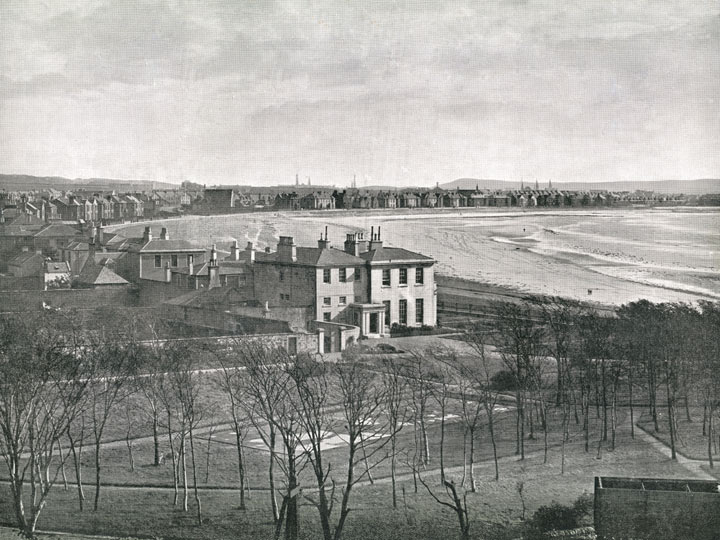
outcome of this was that the house "Pavilion" on 3.4 acres of ground
with two lodges, stables and walled garden was sold by the Earl of Eglinton
and Winton to the Archdiocese of Glasgow on 30 January 1924 for £4500.
During the 1914-1918 war the house, under Government control, had been used
as a convalescent home for injured servicemen. This piece of ground, originally
an inlet of the sea called Seggany Point Loch, was reclaimed over many years
by the dumping of soil brought from Ireland as ballast in ships. It was the
second largest privately owned residential piece of land in Ardrossan, the largest
being at Seafield Towers in Eglinton Road. Its rateable value was £60.
Opposition
Although the site had been purchased, many years were to elapse before building
began. As a consequence of this the unoccupied house fell into disrepair and
the once well tended gardens became overgrown. Opposition from local people
was encountered on two counts - firstly, a once grand and well maintained mansion
house on the sea front was becoming derelict and detracted from the town; secondly,
the ground had been sold to the Catholic Church! Letters to the Editor appeared
in the Ardrossan and Saltcoats Herald early in 1935: "... the roof of the
old Pavilion is, I understand, to be removed so that the house can be classed
as a ruin on which no rates are payable." The following week the reply
from Father Joseph Doherty, the Parish Priest at Saltcoats read: "May I
inform your correspondent that he is in error when he says that only the roof
of the Pavilion is coming off to save rates. The entire fabric is to be cleared
away at an early date, and in due course the grounds will be so transformed
as to be a credit to Ardrossan." Another letter stated: ". . . then
you let the Pavilion and grounds get into private hands, what an entrance to
the Castle Hill and what a place for a decent pavilion and dance hall. Oh, were
the council asleep!" Ardrossan Town Council, involved in a large house
building programme, had obviously tried to purchase the ground from the Archdiocese
of Glasgow. However, at a Council meeting on 16 December 1935 a letter from
the Archbishop of Glasgow was read indicating the proposed building of a church
on the site of the Pavilion. Housing was out of the question.
Fundraising
During the ten year period that followed the acquisition of the ground, finance
for the building was sought. Before he left Saltcoats in 1926 Father Stephen
Thornton, DSO, arranged with Harry
Kemp, the cinema and music hall owner, for the use of his Assembly Hall
in Bute Place for mass to be said there on Sundays. The first mass to the said
there, and indeed the first mass in Ardrossan since the Reformation, was celebrated
by Father Robert McCliment who
was born in the town. Children's devotions were held in the afternoon. This
avoided the walk to Saltcoats. Father Thornton was awarded the Distinguished
Service Order during the 1914-1918 war when he forced German troops to surrender
armed, though not known to them, with an unloaded rifle! A story of the fundraising
effort tells of "Go as you Please" concerts which took place in the
same hall on Sunday evenings. When visiting homes Father Thornton would cajole
an unsuspecting person to sing at the forthcoming concert. The ability to perform
was not an essential qualification and once word got round that an individual
had been "booked" to entertain, large audiences would turn up to hear
the efforts. Silver collections were taken at these events. In December 1933,
a Social Evening was held in the Beach Pavilion in Saltcoats to augment the
funds. After tea the audience was entertained to "a programme of songs
and dances and interludes by the 'Variety Sparks' from Glasgow". Music
for the dance which followed was provided by Gerard
McCulloch and his Syncopators. In later years he was to become the long
serving organist in Saint Peter in Chains. Willie Shanks and his Band from Ardrossan
also contributed. Whist drives were held in the Masonic Hall in Saltcoats and
"Half Crown Cruises" departed from Ardrossan Harbour. The ship would
sail to Rothesay via the Kyles of Bute with dancing to a band on board. All
this for twelve and a half pence and still a profit was made!
Pavilion
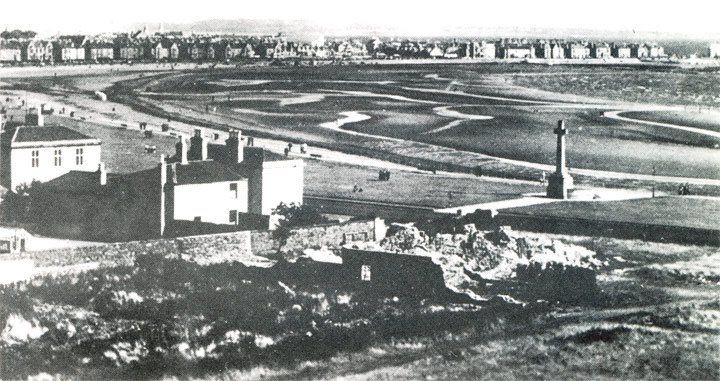
During 1936 the Pavilion was demolished, the wall around the garden was removed
and the site cleared. Work on the building commenced in June of the same year
and was externally completed in September 1937. The pillars on either side of
the main entrance to the church grounds are the original gateposts and date
from around 1815. Originally the wall between the gate and the pillar which
stands halfway along the South Crescent boundary and also the wall which runs
the length of Pavilion Place were twice the height they are now. They were shortened
after completion of the building. At the same time the stables (on the Pavilion
Place wall) and the octagonal lodge which stood to the right of the entrance
and known as the "Umbrella House" because of the shape of its roof
were demolished. Originally it had been considered that this unusual building
could be used as a mortuary chapel. Today it can still be seen where these structures
were by the difference of the stone on the back of the walls. On the low wall
between the centre pillar and that at the boundary with the next house were
very ornate cast iron railings. These were removed in 1940 to provide much needed
metal for the war effort. Again the remains of these can still be seen. The
only other structure remaining is the lodge which can best be seen from Arran
Lane. This building is now the kitchen of the church hall and although it was
re-roofed in the early 1960s the original sandstone walls, erected at the beginning
of the last century, still stand. It was occupied initially by Paddy Murray
and by his successor Michael Meaney who were caretakers and general handymen.
Saint Peter in Chains
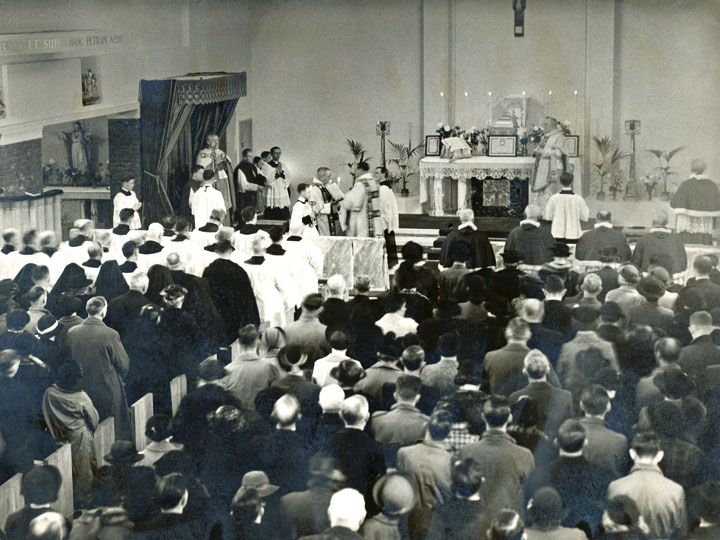
The Church of Saint Peter in Chains was officially opened at noon on Sunday
2 October, 1938 by His Grace the Archbishop of Glasgow, the Most Reverend Donald
Mackintosh. High Mass was said, the celebrant being Father
Archibald McSparran who was assisted by Father
James McCarroll, at that time serving at Saint Joan of Arc in Highbury,
London, and Father Robert McCliment,
OBE, MA, who held the rank of Captain in the Army and served in the trenches
during World War I. All were natives of Ardrossan. The Archbishop was attended
by the Vicar General, Monsignor William Daly and Monsignor Henry Forbes, Rector
of Saint Peter's College, Bearsden. The Sermon was preached by Father Frederick
Pirrie of Saint Mary's, Paisley and Father Thomas Cahill of Saltcoats was Master
of Ceremonies, his assistant being his colleague Father Thomas Maguire. The
choir under the direction of Father Thomas Kelly sang Palestrina's "Missa
Brevis" and was accompanied on a borrowed Hammond organ by Cathie Langan.
Altar Servers included Andrew McCarroll, John McCourt, Frank McEvoy, Jim Courtney
and Arthur Murphy. Saint Peter in Chains was the twenty-third church to be built
for the Archdiocese of Glasgow.
Father Doherty presided at the lunch which was served afterwards in the convent
of the Franciscans of the Immaculate Conception in Montgomerie Crescent in Saltcoats.
Catering was provided by Charles Oxley Lee of the Kilmeny and Eglinton Hotels.
The explanation of the
name Saint Peter in Chains can be found in the Acts of the Apostles, Chapter
12, Verses 1-7.
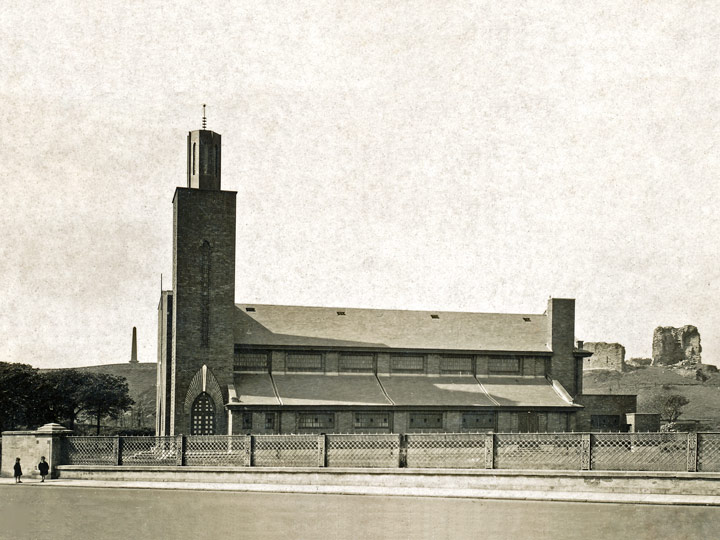
The building,
at that time probably one of the largest brickwork structures in Scotland, is
constructed of "Accrington Nori" rustic facing brick. Findlay and
McGeechan of Glasgow were the builders and employed some local labour. The foreman
bricklayer, Alexander "Sanny" Archibald of Saltcoats, was personally
responsible for the decorative brickwork around the main door and the side door
under the tower. Roof tiles are "Walley's Supero" red rustic sanded
variety. The tower is crowned with an octagonal copper "lantern" now
oxidised green but, no doubt, was bright and shining when erected in 1937. Original
plans were for a light to be installed, but this was opposed by the Commissioners
of Northern Lighthouses, the organisation in Scotland responsible for navigational
buoys and lighthouses around the coast. It was feared that, from the sea, it
could be confused with the lighthouse at the entrance to Ardrossan harbour with
disastrous consequences. The finial on top, 24 metres above the ground acts
as a lightning conductor. The seating, for around 800, is constructed of American
white oak by Thomas Stewart Ltd. who were joiners for the rest of the building.
A contemporary report states that the seating was "specially designed for
comfort in kneeling". However, as many will verify, this comfort disappears
on sitting as the back rests are too low.
The interior was finished
in plaster with cream pigment added. The Stations of the Cross were modelled
and carved by Archibald Dawson, ARSA. The high altar was donated by Harry
Kemp and was constructed and installed by James Youden and Son Ltd. This,
together with the side altars and altar rail, were built using Raw Sienna, Pavonazzo,
Travertine, Arno Aiti and Swedish Green Marble. The crucifix above the high
altar, sanctuary lamps and paschal candle holder were donations from the Langan
family of Ardrossan. The carved wood statue of the Madonna and Child was gifted
by Miss Katherine Shearer of Montgomerie Street and the statue of the Sacred
Heart, which is a copy of the one at Montmartre in Paris was the-gift of Mrs
Jane Reilly of Saltcoats. The pulpit which was external to the sanctuary and
under the canopy bearing the inscription "Tu es Petrus et super hanc petram
aedificabo ecclesiam meam" (Thou art Peter and upon this rock I will build
my church) was of the same wood as the seats and had a red velvet surround.
The baptismal font of granite was situated in the porch. The total cost of the
project was £10000. The large grounds were subdivided into sixty-one sections
and leased to individuals as allotments for cultivation and growing of crops.
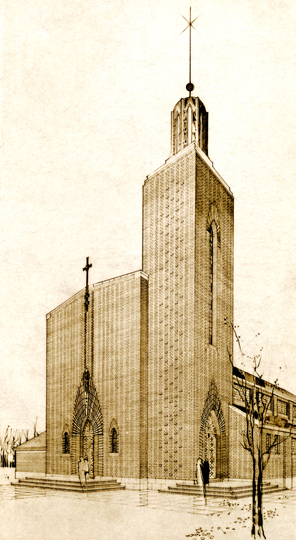 Jack
Coia, CBE, RIBA, was the architect. He was born in 1898 and graduated from
the Glasgow School of Art in 1923. After a short period in London he returned
to Glasgow where he lectured at the School of Art. Later he became a partner
in the firm of Gillespie, Kidd and Coia and designed the Palace of Industry
and the Roman Catholic Pavilion for the Empire Exhibition which took place at
Bellahouston Park, Glasgow in 1938. Renowned for his many church designs, he
received three medals from the Royal Institute of British Architects. These
were for Saint Bride's, East Kilbride, 1963; Our Lady of Good Counsel, Dennistoun,
1966 and Saint Peter's College, Cardross, 1967. In 1969 he received the RIBA
gold medal for architecture. Charles McKean of the Royal Incorporation of Architects
in Scotland in a recent book on architecture of the 1930s comments: "Saint
Peter in Chains marks a departure from the usual. An off-centre, Swedish influenced
tower is an essential part of the composition, the church roof has a much shallower
pitch and the craft details are not superimposed in the stone as in other churches,
but take the form of cut bricks, emphasising an almost Gothic tympanum, and
similar brick detailing surmounts the two flanking windows."
Jack
Coia, CBE, RIBA, was the architect. He was born in 1898 and graduated from
the Glasgow School of Art in 1923. After a short period in London he returned
to Glasgow where he lectured at the School of Art. Later he became a partner
in the firm of Gillespie, Kidd and Coia and designed the Palace of Industry
and the Roman Catholic Pavilion for the Empire Exhibition which took place at
Bellahouston Park, Glasgow in 1938. Renowned for his many church designs, he
received three medals from the Royal Institute of British Architects. These
were for Saint Bride's, East Kilbride, 1963; Our Lady of Good Counsel, Dennistoun,
1966 and Saint Peter's College, Cardross, 1967. In 1969 he received the RIBA
gold medal for architecture. Charles McKean of the Royal Incorporation of Architects
in Scotland in a recent book on architecture of the 1930s comments: "Saint
Peter in Chains marks a departure from the usual. An off-centre, Swedish influenced
tower is an essential part of the composition, the church roof has a much shallower
pitch and the craft details are not superimposed in the stone as in other churches,
but take the form of cut bricks, emphasising an almost Gothic tympanum, and
similar brick detailing surmounts the two flanking windows."
New Parish
Although the church in Ardrossan had been completed it was many years
before the parish had a priest of its own. It continued to be served from Saltcoats,
initially by Father Doherty and from 1939 by Father, later Canon, Michael O'Connor.
The first marriage in the new church was that of Thomas Bernard Smyth to Elizabeth
Veronica Marshall on the day after the opening. The first baptisms, of Thomas
Peter McCann, son of Thomas McCann and Mary Agnes Murray and Henry Joseph Sammons,
son of Joseph Sammons and Sarah Quinn took place on Sunday 13 November 1938.
The first Requiem Mass was for Robert Hastings on 30 December 1938. During the
war years, if German air raids were anticipated, a priest would sleep in the
church as a precaution in the event of an outbreak of fire. Fortunately his
services were never required.
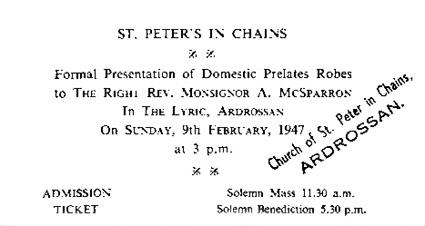 In
1946, Archbishop Mackintosh transferred Father
McSparran from Saint John the Evangelist in Glasgow to be the first Parish
Priest of Saint Peter in Chains. This was a unique appointment as he was a native
of the town. The following year the first assistant priest, Father
Matthew Littleton, was assigned to the parish and Father
McSparran was made a Domestic Prelate.
In
1946, Archbishop Mackintosh transferred Father
McSparran from Saint John the Evangelist in Glasgow to be the first Parish
Priest of Saint Peter in Chains. This was a unique appointment as he was a native
of the town. The following year the first assistant priest, Father
Matthew Littleton, was assigned to the parish and Father
McSparran was made a Domestic Prelate.
At a function in the Lyric Cinema, Ardrossan on 9 February 1947 Monsignor
McSparran was presented with a cheque by James Dorrian on behalf of the
parishioners. Prior to this, Daniel Scullion, headmaster of Ardrossan Central
School, presented the new Monsignor with a set of Breviaires from the staff
and pupils. In October 1948 parishes in the North Ayrshire district became incorporated
in the Diocese of Galloway which was administered from Dumfries. Previously
they had been part of the Archdiocese of Glasgow. During his tenure of office
Monsignor McSparran's health
deteriorated. He died on 10 March 1950. His successor was Father
Peter Fitzpatrick who had previously been Parish Priest at Saint Palladius',
Dalry. The same year Father Littleton
was transferred to Our Lady of Lourdes and Saint Patrick, Auchinleck and was
succeeded by the newly ordained Father
James O'Sullivan. Father Fitzpatrick
was appointed to the Cathedral Chapter in November 1951. His sudden death on
6 January 1952 precluded his installation. Father
William McBurnie succeeded him. His stay at Ardrossan lasted less than two
years; he died while visiting his father on 22 August 1953 in his native Dumfries.
In the six years since the first appointment three priests held the charge and
all had died in office.
While having dinner with some other priests shortly after his arrival at Ardrossan in October 1953, Father Lawrence Walls Fischer was jokingly told by his colleagues, that in the light of previous events, he would live only another six months. This was, of course, far from the truth as, in fact, he was the longest serving Parish Priest. His first mass in Saint Peter in Chains was on the Nineteenth Sunday after Pentecost and he introduced himself to the congregation by referring to the Epistle of that day: "Brethren: Be ye renewed in the spirit of your mind and put on the new man...". "I am the new man", he said. His "reign", which was to span 27 years, had begun.
At the same time, a year
after he was ordained, Father Charles
Matthews was appointed assistant to Father
Fischer. Father Matthews could
be seen pedalling about the town on his green and white bicycle in the course
of his duties. In February 1955, Father
Fischer celebrated the silver jubilee of his ordination to the priesthood
and at a function held in Castlecraigs was presented with a silver tea service
on behalf of parishioners.
As there was no presbytery beside the church, the priests lived at 9 South Crescent.
This was half of a large three storeyed semi-detached house, the other half
being the Convent of the Sisters of Misericorde of Sees. In October 1945, application
was made from the Mother House of the Congregation to the Archbishop of Glasgow
for permission to open a new house in Ardrossan. On 6 May 1946 Archbishop Campbell
replied and in 1947 the sisters arrived. This order of nuns, of French origin,
was known locally as the "Nursing Sisters", many being trained nurses.
After difficulties encountered on their arrival, they became accepted and respected
by the whole community. They did invaluable work attending the old and the sick
in Ardrossan and neighbouring towns. They, like Father
Matthews, also got around on bicycles, although in later years they adopted
"mopeds" as their means of transport. A great event, at that time,
was the annual whist drive to help support the Sisters. A target of a hundred
tables was set but there were always more. A committee was formed to organise
this function and their first meeting was held in Delgreco's Restaurant (now
Eugene's) in Princes Street. The office-bearers were: President, James Dorrian;
Vice President, James McGrattan; Treasurer, Harry Spencer and Secretary, Dolores
McNamara. This was the beginning of the Parochial Committee which served for
many years and organised the popular and well attended Saint Patrick's and Saint
Andrew's Nights. Parochial Reunions and Church Workers' Socials were also held.
Entertainment was provided by "Concert Parties" and these shows, in
Castlecraigs, would be compered by the ever funny Joe Long who was billed as
"Ayrshire's Ace Comedian". The Garden Fete or Sale of Work was an
annual event held in July and it was customary for a prominent person or celebrity
to open it. These included Sir Patrick Dollan, former Lord Provost of Glasgow,
Bishop Joseph McGee, Raymond Boyd of Scottish Television and Bobby Lennox of
Celtic Football Club and Scotland. In 1957 the fete was opened by Monsignor
John Power, who as a junior priest in Saltcoats in November 1916, became well
known for his courage in attending men who were trapped in the hold of the Norwegian
grain ship "Hjortnes" which went aground on Horse Island. Many people
will remember the Garden Fete when large crowds turned up hoping to see Larry
Marshall of Scottish Television's One O'Clock Gang, but, after patiently waiting
in worsening weather conditions, the fete got under way without him. He forgot
to come! The Saint Vincent
de Paul Society Conference in Ardrossan was formed six months after separation
from Saltcoats with members continuing to attend meetings there until they became
established at Saint Peter in Chains. Their meeting place was an outhouse behind
the presbytery at 9 South Crescent. The Society is still going strong and is
the longest serving organisation within the parish. The Legion
of Mary formed
their own group in Ardrossan and during the early 1960s members could be seen
along the promenade with their specially constructed barrow selling Catholic
Truth Society publications and Catholic newspapers.
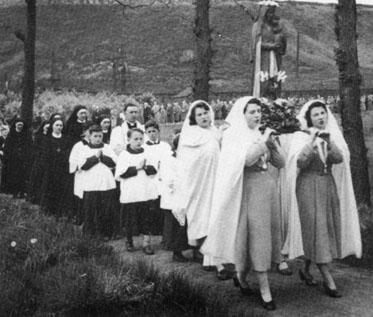
Processions in the church grounds were another summer feature. On a Sunday in
May the statue of the Madonna and Child would be removed from the side altar
and fitted to a frame which would be carried shoulder high by members of the
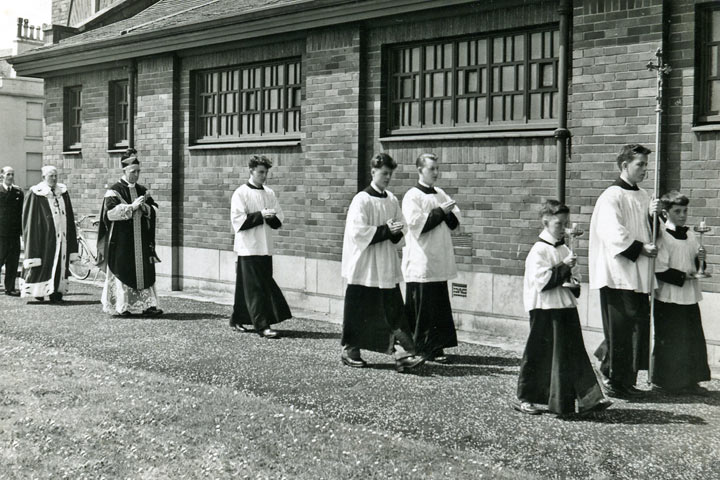
Sodality of the Children of Mary. The Corpus Christi processions took place
in June when the Blessed Sacrament would be borne by the priest under a canopy
and escorted by members of the Saint
Vincent de Paul Society or Knights of Saint Columba to an outdoor altar
for Benediction. Hymns sung during these occasions were led by the choir under
the direction of John Cosgrove who is still choirmaster. Large crowds of onlookers
would gather on Castle Hill at these events.
Saint
Anne's Guild was started in 1947 by Annie and Theresa Marron and met above
their shop in Princes Place. The Guild has been active ever since. Mary O'Hare,
later Mrs McLaughlan, played a big part in Saint
Anne's Guild and the Parochial Committee. In recognition of her work she
was elected Catholic Woman of the Year in 1972.
Presbytery and Halls
Plans for a new presbytery were drawn up in 1955. Once again Jack Coia was the architect responsible and in the following year work began on the building of the house beside the church. This had been preplanned when the church was designed in 1936. Father Fischer was impatient to move in; his bed was taken along and he stayed there to look after valuables, carpets, etc! The builders finished the job around him. The house, which was built to accommodate three priests and a housekeeper so well matches the church, that in the subsequent weathering, the age difference of twenty years is not at all obvious. The following year the garage and sheds to the rear of the church and the wall between the side of the house and the boundary were added. The then vacant 9 South Crescent was taken over by the Sisters of Misericorde of Sees thus doubling the size of their convent and named Saint Theresa's House.
Around this time a Boys'
Club was formed, and met regularly in the Labour Hall "up a close"
in Glasgow Street. Father Matthews
with men from the parish played a very active part.
In May 1958,
James Dorrian, for many years a local councillor and an active member of the
Parochial Committee and Saint
Vincent de Paul Society was elected Provost of Ardrossan Town Council. His
Robes and Chain of Office were presented to him at a ceremony in Ardrossan Burgh
Chambers in Kilmahew Street by Sheila Kennedy and Mary O'Hare. It was traditional,
in those days, for a new Provost and his Council to attend church on the Sunday
after the election for what was known in the Church of Scotland as the "Kirkin'
o' the Cooncil". So it became that Provost Dorrian, accompanied bv council
members and Burgh officials was "kirked" in Saint Peter in Chains.
Special Collections on many Sundays were for the "Reduction of Debt" and these ended in November 1962 when the final debt was cleared. These collections were thereafter for the "Renovation Fund". This and the monthly collection for men and women which was uplifted by volunteers going door to door ended in December 1964. On the first Sunday of 1965 the Freewill Offering or "Pledge" system was inaugurated
In March 1963 Saint Peter's Association was formed as a fund-raising organisation to encourage interest in the welfare and activities of the youth of the parish. Many social functions were held to this end. "Record Hops", perhaps the forerunner of the modern day disco, were held on Sunday evenings, when the church hall would be full to capacity.
The Silver Jubilee of the church of Saint Peter in Chains took place on 2 October 1963 and for the occasion the church was painted internally. Stations of the Cross and light fittings were removed, statues and crucifixes were stowed away for safe keeping, dust sheets were draped everywhere and a huge scaffolding was erected.
The priests received gifts from the parishioners and the parish children were entertained in the Regal Cinema in Saltcoats with the compliments of the Kemp family. In the same year Father Matthews who had served for 11 years, the longest term of any assistant priest, moved to Saint Thomas Apostle, Muirkirk. He was replaced by Father John Murphy who was to remain just over a year.
At this time work was
started on the erection of a hall under the supervision of John
Dolan. Many volunteers did the preparatory work and assisted with the internal
finishing. Originally a wooden structure, the roof was raised, a new floor laid
and, more recently, brick walls were added. Shortly afterwards, as a result
of new building at Seafield Residential School in Eglinton Road, wooden "huts"
which had been previously used as dormitories became available. The building
now known as "The Lounge" was dismantled by Hugh Conway and a few
youths, transported and re-erected to become a workshop for the use of the Boys'
Club.
1964 saw the arrival of Father John Walls,
a native of Ayr. During his time at Ardrossan he started Saint Joseph's Guild
which was a discussion group for men on the various aspects of the Church.
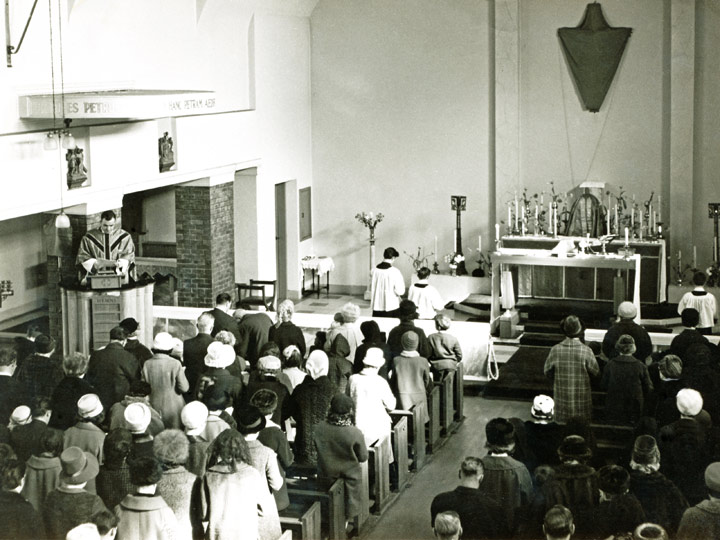
Mass
in Saint Peter in Chains in English was said for the first time at 7 00 pm on
Friday 2 March 1965. This rite, much different from today, was a direct translation
from the Latin and the priest faced the congregation. As the space behind the
high altar was limited this was made possible by the erection of a temporary
wooden altar in front. That year also saw most Holy Week services in English
and the first lay lector read from the altar in November. Fatima Novena Devotions
on a Friday evening were replaced by mass.
On 20 September 1965, clergy from the six churches in the town met to discuss the formation of a local Council of Churches. The first project was the erecting of a Nativity Scene in the grounds in front of Castlecraigs and on 22 December 1965 the first united Christmas Service of Carols was held. This event was popular for many years but has since been discontinued.
Rosary was said in the
homes of parishioners, on a rota basis, on weekday evenings by members of the
Saint Vincent de Paul Society or Legion
of Mary.
On 12 June 1966, an Evening Service of hymns and readings was broadcast "live"
from Saint Peter in Chains on the Scottish Home Service of the BBC and was led
by Father Walls.
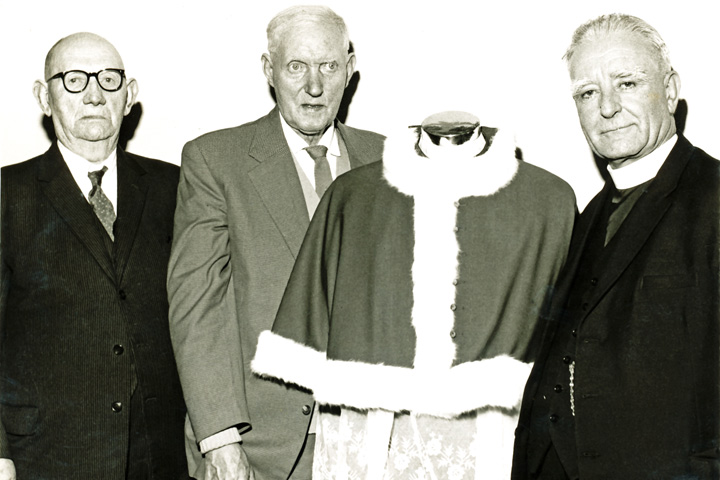
In October 1966 Bishop McGee announced that Father
Fischer was to be made a member of the Cathedral Chapter and a committee
was formed to organise the presentation of his Canonical Robes. This took place
at a function, to a full house, in Castlecraigs on Sunday 18 December 1966.
Clergymen from all the churches in Ardrossan were invited as were priests from
the neighbouring towns, former priests of Saint Peter in Chains and local dignitaries.
The presentation was made by Patrick Cunningham and Hugh Magee, the oldest male
parishioners. The address to Canon
Fischer was read. He replied and other speakers contributed. In the concert
which followed, it was noteworthy that every performer was a parishioner. Canon
Fischer was for many years Diocesan Master of Ceremonies and also Treasurer
of the Pontifical Society for the Propagation of the Faith in the Diocese of
Galloway.
The following year, Henry McFarlane
became the first native of Ardrossan to be ordained in Saint Peter's. The ordination
by Bishop McGee took place on 1 July 1967. Subsequently Father McFarlane took
up an appointment at Saint Mary's in Irvine.
Funds became available for the purchase of a pipe organ. This replaced the increasingly unreliable electronic instrument which had been purchased twenty-two years previously for £200. It was not unknown for the organist to transfer "mid-hymn" to the old harmonium which was on stand-by. J W Walker and Sons of Ruislip, who supplied the organ for the Metropolitan Cathedral of Christ the King in Liverpool built and installed the organ in the space that had been left in the original design, for such an eventuality. The total cost was £5518. The first sung mass in English, the music of which was written by Father, now Monsignor, Francis Duffy VG, was celebrated on the feast of Christ the King in 1967.
In May 1968, the 8 00 am morning mass was discontinued in favour of the later time of 10 00 am and in August, Holidays of Obligation ceased to be a holiday from school. In the same year, Father Walls left to take up an appointment at the Good Shepherd Cathedral, Ayr and was replaced by Father Alistair Grant Tosh. The original pulpit was removed and a new, though temporary one, was constructed and erected inside the sanctuary and the rite of mass, which remains today, was introduced.
In 1971, the Verona Fathers bought the house at 8 South Crescent at one time owned by Harry Hopperton, Provost of Ardrossan from 1935 to 1938. Named Saint Joseph's House, it became a noviciate of the order which is also known as the Comboni Missionaries of the Heart of Jesus. The house was opened on 24 October 1972 by Bishop McGee and the first community under the direction of Father Stanislaus Woods, Superior and Father Joseph Valenti, Novice Master, consisted of four Aspirants to the Brotherhood and two Postulants for the Noviciate.
In the summer of 1974,
Father Tosh was appointed to Saint
Palladius', Dalry and his successor was Father
Declan Kelly. In 1977, after thirty years service to the community, the
"Nursing Sisters" sold their convent at 9/10 South Crescent and moved
to a smaller house in Irvine. In September 1983, they left Scotland completely
and returned to the Mother House in France.
Major alterations to the sanctuary took place in 1979. Jack
Coia, then in retirement at Glendaruel, supervised the removal of the altar
rails and the dismantling and re-modelling of the high altar which was replaced
forward of its original position. The "horns" on either side on which
the sanctuary lamps stood, were removed. The new tabernacle was installed in
the back wall. Marble from the altar rails, in conjunction with new material,
was used to manufacture the baptismal font and pulpit. New lighting was installed
throughout the church which was re-painted.
During the late 1970s, Canon Fischer's health deteriorated to such an extent that he became housebound. He died in Ballochmyle Hospital on 10 October 1980. His requiem mass was concelebrated by over fifty of the clergy of the Diocese and the homily was given by the Vicar General, Monsignor Duffy in the absence of Bishop McGee who was abroad. He was buried in Ardrossan Cemetery alongside two of his predecessors, Monsignor McSparran and Canon Fitzpatrick.
After Canon Fischer died, Father Kelly was transferred to Saint Thomas, Apostle in Muirkirk. Father Michael Lynch came from Kirkcudbright in November 1980 to take over as sole priest.
The Saturday vigil mass was introduced with singing being led by music provided by guitars, mandoline and tambourine. Father Joseph Glendinning who had been ordained a few months previously at Saint Winin's, Kilwinning, was appointed assistant in 1981. He remained only a short time and was transferred to Newton Stewart in May 1982 again leaving the parish in the sole charge of one priest.
The second ordination in Saint Peter in Chains took place on 2 July 1981. Peter Magee was ordained by Bishop Maurice Taylor who had been consecrated on 7 April 1981 after the death of Bishop McGee. Bishop Taylor, previously Monsignor, was parish priest at Our Lady of Lourdes, East Kilbride.
Sisters of the Franciscans of the Immaculate Conception, who twenty years previously had a house in Montgomerie Crescent in Saltcoats, set up a convent at 46 Stanley Road in 1982. Their present convent at 23-25 McKellar Avenue was opened in May 1986.
In 1983, the long running Parochial Committee was replaced by the Parish Council and drew its members from different groups and organisations within the parish. In the same year the newly ordained Father John McCaig, who had previously spent his Diaconate at Ardrossan, was appointed assistant and served until 1986 when he was transferred to Saint Meddan's in Troon and was succeeded by Father Paul O'Brien, a Carmelite from Portsmouth.
Over the past fifty years
Saint Peter in Chains parish has grown considerably with a Catholic population
of four thousand and is now the largest parish of the forty-four in the Diocese
of Galloway.
The Future
Father Michael
Lynch writes:
A Golden Jubilee is a time for thanks and appreciation. We take the opportunity
of thanking all who have contributed to the growth and development of the community
of Saint Peter in Chains. The spiritual and physical contours of the parish
have changed over the past fifty years and will continue to do so as we move
into another century and help to build the City of God. We would do well to
remember the words of Pope John Paul II on 1 June 1982 in Bellahouston Park,
Glasgow: "You originate in a glorious past but you do not live in the past.
You belong to the present and your generation must not he content simply to
rest on the laurels won by your grandparents and great grandparents. You must
give your response to Christ's call to follow Him and enter with Him as co-heirs
into His Father's Kingdom."
May God bless the Parish
of Saint Peter in Chains. May he bless all those who visit us, work with us,
and pray with us now and in the future.
Parish Priests
ARCHIBALD McSPARRAN, 1946-1950: Born 22 August, 1882 at Ardrossan. Educated at Saint Mary's School, Saltcoats; Saint Mary's College, Blairs; Saint Peter's College, Bearsden. Ordained at Saint Andrew's Cathedral, Glasgow, 24 June, 1908. Served at Saint Patrick's, Dumbarton, 1908-1927; Saint Patrick's, Strathaven, 1927-1930; Holy Cross, Croy, 1930-1933; Saint John's, Glasgow, 1933-1946, Saint Peter in Chains 1946-1940, Domestic Prelate, 1947. Died at Ardrossan, 10 March 1950, aged 67.
PETER FITZPATRICK, 1950-1952: Bom 22 March, 1888 at Foxford, County Mayo. Educated at Saint Jarlath's, Tuam; Missionary College of All Hallows, Dublin; Saint Peter's College, New Kilpatrick. Ordained at Saint Andrew's Cathedral, Glasgow, 28 June 1914. Served at Saint Joseph's, Tollcross, 1914-1933; Saint Patrick's, Strathaven, 1933-1937; Saint Palladius', Dalry, 1937-1950; Saint Peter in Chains, 1950-1952. Member of Cathedral Chapter, November 1951. Died at Ardrossan, 6 January 1952, aged 64.
WILLIAM McBURNIE, 1952-1953: Born 3 May, 1892 at Maxwellton, Dumfries. Educated at Saint Joseph's College, Dumfries; Saint Mary's College, Blairs; Scots College, Rome. Ordained at Seminary Chapel, Rome, 24 April 1921. Originally on loan to the Archdiocese of Saint Andrew and Edinburgh. Served at Saint John the Evangelist, Cumnock, 1922-1925; Saint Joseph's, Kilmarnock, 1925-1927; Saint Margaret's, Ayr. 1927-1933; Saint Francis Xavier, Waterside, 1933-1937; Saint Sophia's, Galston, 1937-1939; Saint Andrew and Cuthbert, Kirkcudbright, 1939-1952; Saint Peter in Chains, 1952-1953. Died at Dumfries, 22 August 1953, aged 61.
LAWRENCE WALLS FISCHER, 1953-1980: Born 31 August 1904 at Gateshead-on-Tyne, Northumberland. Educated at Saint Mary's College, Blairs; Scots College, Rome. Ordained at Lateran Seminary, Rome, 16 February 1930. Originally on loan to the Archdiocese of Saint Andrew and Edinburgh. Served at Saints Ninian and Triduana, Restalrig, 1930-1931; Saint Joseph's, Kilmarnock, 1931-1939; Our Lady and Saint Cuthbert, Maybole, 1939-1945; Saint Francis Xavier, Waterside, 1945-1953; Saint Peter in Chains, 1953-1980. Member of Cathedral Chapter, October 1966. Died at Ballochmyle, 10 October 1980, aged 76.
MICHAEL
LYNCH, 1980-: Born 21 February 1931 at Cork. Educated at Saint Patrick's
College, Carlow. Ordained at Carlow Cathedral, 5 June 1955. Served at Saint
Margaret's, Ayr, 1955-1960; Our Lady Star of the Sea, Saltcoats. 1960-1964;
Saints Andrew and Cuthbert, Kirkcudbright, 1964-1980; Saint Peter in Chains.
1980-.
Assistant Priests
MATTHEW LITTLETON, 1946-1950: Born 8 December, 1903 at Dangan, County Clare. Educated at Saint Flannan's College, Ennis; Missionary College of All Hallows; National University of Ireland. Ordained at Dublin, 16 June 1929. Served at Saint Patrick's, Anderston, 1929; Holy Cross, Croy, 1929-1932; Saint Joseph's, Glasgow, 1932-1936; Saint Columbkille's, Rutherglen, 1936-1939; Saint John the Baptist, Port Glasgow, 1939-1946; Saint Peter in Chains, 1946-1950; Our Lady of Lourdes and Saint Patrick, Auchinleck, 1950-1953; Saint Joseph's, Kilmarnock, 1953-1977. Member of Cathedral Chapter, 1966. Freeman of the Burgh of Kilmarnock, 1975. Died at Kilmarnock, 9 August, 1977, aged 73.
JAMES O'SULLIVAN, 1950-1953: Born 18 September, 1923 at Cork. Educated at Saint Finbarr's Seminary, Cork; Saint Patrick's College, Carlow. Ordained at Carlow, 5 June, 1949. Served at Saint Peter in Chains. 1950-1953. Emigrated to America, 1953.
CHARLES MATTHEWS, 1953-1963: Born 19 November 1927 at Clooneen, Granard, County Longford. Educated at Saint Mel's College, Longford; Saint Peter's College, Wexford. Ordained at Wexford, 8 June 1952. Served at Saint Joseph's, Kilmarnock, 1952-1953; Saint Peter in Chains, 1953-1963; Saint Thomas, Apostle. Muirkirk, 1963-1980; Saint Joseph's, Catrine, 1980-1982; Our Lady of Perpetual Succour, Millport, 1982-1987; Saint Mary's, Irvine, 1988-.
JOHN MURPHY, 1963-1964: Born 19 May 1930 at Annbank. Educated at Saint Margaret's School, Ayr; Saint Mary's College, Blairs; Propaganda Fide College, Rome. Ordained at Saint Andrew's Cathedral, Dumfries, 16 July 1954. Served at Saint Joseph's, Kilmarnock, 1954-1958; Saint Andrew's Cathedral. Dumfries, 1958-1963; Saint Peter in Chains, 1963-1964; Saint Conal's, Kirkconnel, 1964-1971; Saint Columba's, Annan, 1971-1978. Died at Nithsdale, 25 April 1978, aged 48.
JOHN WALLS, 1964-1968: Born 10 February 1937 at Ayr. Educated at Saint Mary's College, Blairs; Royal Scots College. Valladolid. Spain. Ordained at Valladolid, 18 March 1961. Continued his studies at Scots College, Rome, 1961-1964; Saint Peter in Chains, 1964-1968; Good Shepherd Cathedral, Ayr. 1968-1970; Royal Scots College, Valladolid, Vice Rector, 1970-1974; Rector, 1974-1981; Saint Paul's. Hurlford, 1981-. Member of Cathedral Chapter, 1977.
ALISTAIR GRANT TOSH, 1968-1974: Born 3 September 1939 at Dumfries. Educated at Saint Joseph's College, Dumfries; Saint Mary's College, Blairs; Saint Andrew's College, Drygrange. Ordained at Saint Theresa's, Dumfries, 30 March 1963. Served at Our Lady of Mount Carmel, Onthank, 1963-1968; Saint Peter in Chains, 1968-1974; Saint Palladius', Dalry, 1974-1976; Holy Trinity, Lockerbie, 1976-1982; Saint Brigid's, Kilbirnie, 1982-.
DECLAN KELLY, 1974-1980: Born 11 November 1944 at Cooraclare, County Clare. Educated at Saint Flannan's College, Ennis; Saint Patrick's College, Carlow. Ordained at Carlow Cathedral, 7 June 1969. Served at Saint Mary's, Irvine, 1969-1970; Saint Brendan's, Saltcoats. 1970-1971; The Sacred Hearts of Jesus and Mary, Girvan, 1971-1974; Saint Peter in Chains, 1974-1980; Saint Thomas. Apostle, Muirkirk, 1980-1985.
JOSEPH GLENDINNING, 1981-1982: Born 21 June 1916 at Wakefield, Yorkshire. Educated at Saint Michael's College, Leeds. Worked for the London, Midland and Scottish Railway and served in the Royal Air Force during World War II. Returned to British Railways and retired as Chief Personnel Officer, Scottish Region, British Rail in 1976. Following the death of his wife in 1977, he entered the Pontifical Beda College, Rome. Ordained at Saint Winin's, Kilwinning, 3 December 1980. Served at Saint Winin's, Kilwinning, 1981; Saint Peter in Chains, 1981-1982; Our Lady and Saint Ninian. Newton Stewart. 1982-.
JOHN McCAIG. 1983-1986: Born 26 August 1957 at Kilmamock. Educated at Saint Joseph's Academy, Kilmarnock; Heriot-Watt University, Edinburgh; Royal Scots College, Valladolid; Pontifical University of Comillas. Ordained at Good Shepherd Cathedral Ayr, 8 July 1983. Served at Saint Peter in Chains, 1983-1986; Our Lady of the Assumption and Saint Meddan, Troon, 1986-1987.
PAUL
O'BRIEN, O Carm 1986-. Born 18 November 1955 at Portsmouth, Hampshire. Educated
at Downside School, Somerset; Gregorian University, Rome. Ordained at The Friars,
Aylesford, 19 July 1981. As a Carmelite priest he served as chaplain in Bellevue
Hospital, New York. Served at Saint Columba's, Annan, 1986; Saint Peter in Chains,
1986-.
Vocations from the Parish
PRIESTS
Bernard O'Brien. Ordained at English College, Lisbon for Diocese
of Brentwood, 8 June 1963.
Henry McFarlane.
Ordained at Saint Peter in Chains for Diocese of Galloway, 1 July 1967.
Peter Magee. Ordained
at Saint Peter in Chains for Diocese of Galloway, 2 July 1981.
Stephen Motroni,
SCJ. Ordained at Our Lady,
Star of the Sea, Saltcoats, 4 June 1983.
Gerard Magee, Dom
Joseph Magee, OSB. Ordained at Saint Augustine's College, Westgate on Sea, Kent,
1 March 1986.
NUNS
Monica
Coulter, Sister Mary of Saint Joseph, Carmelites.
Moira Donnelly,
Sister Moira, Society of the Sacred Heart.
Anne Mane Quigg, Sister Anne Marie, Verona Sisters.
Saint Peter's Primary
School
Ardrossan Central School was opened on 26 August 1935 and provided for both
primary and secondary pupils, the latter being drawn from the area Largs to
Kilwinning.
Originally built in 1882 as Ardrossan Academy, the accommodation was increased
when a two storey extension was completed in 1900 to include a secondary department.
A large gymnasium was added later. In 1933, this school as transferred to larger
premises in Sorbie Road.
Prior to the provision of a school in Ardrossan, pupils were educated at Saint
Mary's School in Springvale Street, Saltcoats. Under Headmaster Daniel Scullion,
the staff of the new school included Miss Baillie, Miss Canning, Miss Grant,
Mrs Grant, Mr McAllister, Miss McCubbin, Mr McGrath, Mr Neill, Mr Prendergast
and Mr Trayner. Mr Stephen Neill, an official of the Schools Association ran
the football team. In its first year 1935-1936, there were 270 primary pupils
and 150 in the "Advanced Division" as the junior secondary department
was then known. The senior secondary school was Saint Michael's College in Irvine.
In the years before the war a school magazine appropriately called "The
New Venture" was published annually and included contributions from parents
as well as pupils.
With the increase of the leaving-age from 14 to 15 years in 1946, it became
necessary to increase the size of the school and the "Annexe" at Ailsa
Gardens was built. This was in the centre of the new housing area and accommodated
pupils in the early years of primary education. The school consisted of three
"Horsa" type precast concrete huts with asbestos roofs which offered
no insulation and were arranged on three sides of a square which formed the
playground. Among the original teachers were the Misses Coogan, Miss McKay and
Mrs Melvin.
Daniel Scullion, after twenty years service as Headmaster died on 24 May 1955
and was succeeded by Patrick Trayner. In the same year the school was renamed
Saint Peter's Roman Catholic Junior Secondary School.
In 1957, the school uniform was introduced and in 1960 the first ever "school
trip" took place. The entire school embarked on a special train at South
Beach station bound for Largs where they boarded the "Maid of Skelmorlie"
for a cruise to Rothesay.
Damage estimated at £16000 was caused by a fire which occurred on 23 February
1964. The outbreak was discovered shortly before midnight and was attended by
units from Ardrossan, Dalry and Kilbirnie. Believed to have started in the janitor's
room, it spread to the domestic science room, gymnasium and book store. The
excellent gymnasium was completely destroyed and was never rebuilt.
With a rising population accommodation both at Ailsa Gardens and South Crescent
was becoming inadequate. In 1963, seven classrooms at the former Saltcoats Public
School in Argyle Road were taken over when this school was transferred to a
new building in Jack's Road. Pupils from Ardrossan continued to travel to Saltcoats
until 1967 when classrooms in the Eglinton School in Ardrossan became available
following its move to Stanley School. The fact that so many different schools
were used meant that some pupils completed their primary education without having
been in the main building at South Crescent. In June 1971, Ailsa Gardens Annexe
closed and in August of the same year, on the introduction of comprehensive
education, pupils from Saint Peter's were transferred to Saint Andrew's Academy,
Saltcoats. This school had previously been Saltcoats Secondary School. In June
197,2 the former Eglinton School which was built in 1876 was closed. These changes
meant that Saint Peter's Primary School came into being and for the first time
in 26 years the school was on the one site though with numerous alterations
and extensions, not under the one roof.
During the summer holiday that followed its last year as a secondary school,
on 1 July 1971, a second fire broke out. The fire, of unknown origin, started
in the Headmaster's room on the ground floor and spread to the first floor and
roof space. Water tenders from Ardrossan, Irvine North, Dalry and Irvine fire
stations attended the incident. Three youths were subsequently apprehended and
found guilty of breaking into the school but not guilty of wilful fire raising.
All school records, bank books and log books were lost in the fire.
At Easter 1972, Patrick Trayner, Headmaster since 1955, retired having served
since the school opened 36 years previously. His successor was Samuel Brogan
who served until 1976 when Paula Coia became Head Teacher. Under Mrs Coia, the
school has a present role of nearly four hundred.
Acknowledgements
In the preparation of this commemorative booklet, help has come from many sources.
My grateful thanks are extended to those who contributed in any way - in particular
to my mother Alice McGrattan, Bernard Aspinwall, Kevin Cunningham, Maggie Edmunds,
Cathie Langan, Fathers Michael Lynch,
Peter Magee and Umberto Pasqualone,
Rose McCann, Andrew McCarroll, Peter McCourt, Pat McKay, Bobby McVeigh, Ian
Russell, Patrick Trayner and John Walsh who provided photographs etc or with
the benefit of age recalled their memories to provide the accurate information
required for a publication of this kind. Thanks also to the Local History department
of Ardrossan Library, the North Ayrshire Museum, Saltcoats, the Mitchell Library,
the Scottish
Catholic Observer
and the Archdiocese of Glasgow for the use of their resources.
Appendix
VOCATIONS FROM ARDROSSAN WHILE PART OF THE PARISH OF OUR
LADY, STAR OF THE SEA, SALTCOATS
JAMES McCARROLL. Born 5 February, 1883 at Ardrossan. Educated at Saint Mary's
School, Saltcoats; Saint Aloysius College, Glasgow; Saint Mary's College, Blairs;
Grand Seminary of Saint Sulpice, Paris. Ordained for Archdiocese of Westminster,
London, 4 July 1908. Chaplain at Holloway and Pentonville Prisons 1908-1916
where he witnessed eight executions including those of "Doctor" Crippen
and Roger Casement, the Irish patriot. Died at London, November 1952, aged 69.
ROBERT McCLIMENT, OBE. Born 2
June, 1887 at Ardrossan. Went at an early age to Folkstone where his father
was a marine engineer with the South Eastern and Chatham Railway Company. Educated
at Saint Edmund's College, Ware. Ordained in 1913. Continued his studies at
Trinity College, Cambridge where he graduated Master of Arts. Served as Captain
in the Army, 1914-1918. Headmaster at Gunnersby School which was founded by
Cardinal Herbert Vaughan. Died at London, 1967, aged 80.
CHURCHES DESIGNED
BY JACK COIA, CBE, RIBA
Saint
Anne's, Glasgow, 1933
Saint Patrick's, Greenock, 1935
Saint Peter in Chains, Ardrossan, 1938
Saint Columbkille's, Rutherglen, 1940
Saint Columba's, Glasgow, 1941
Saint Paul's, Glenrothes, 1958
Saint Mary of the Angels, Falkirk, 1960
Saint Charles', Glasgow, 1960
Saint Mary of the Assumption, Bo'ness, 1961
Saint Bride's, East Kilbride, 1963
Our Lady of Good Counsel, Dennistoun, 1965
Saint Peter's College, Cardross, 1966
Jack
Coia died on 4 August 1981.
VERONA FATHERS AT SAINT JOSEPH'S HOUSE
Staninlaus Woods, Superior, 1972-76
Joseph Valenti, Novice Master, 1972-73
Peter Zuani, Novice Master, 1973-75
Robert Staton, Novice Master, 1976-81
Luciano Fulvi, Vocational Promoter, 1973-76; Superior, 1976-83
John Downey, Superior, 1979-83
Peter Villani, 1979-80
Filiberto Polato 1980-87
Andrew Minisini, 1984-85
Umberto Pasqualoni, 1983-